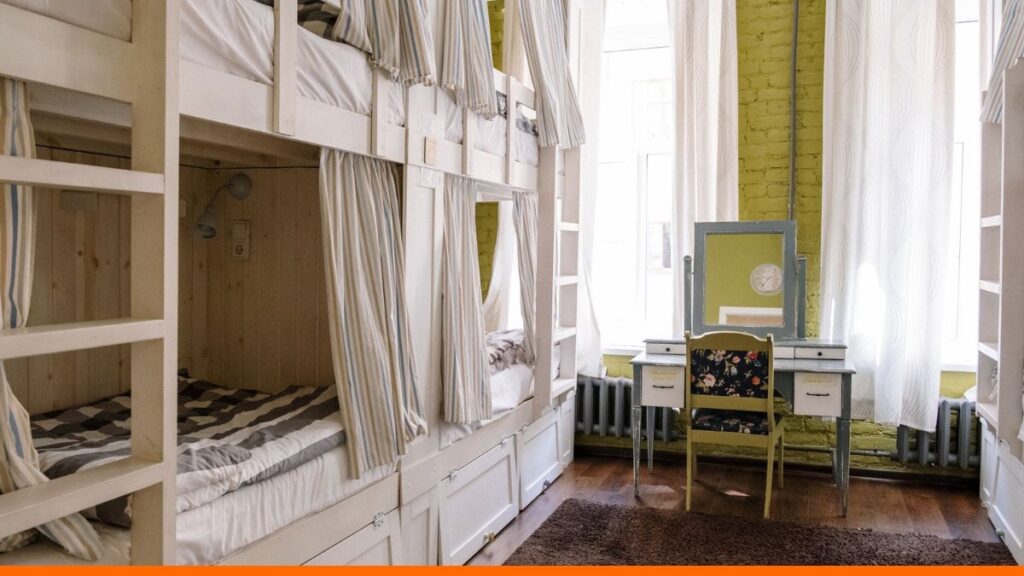
In short: If the agency (uitzendbureau) provides your housing, three rules apply that you should know by heart. One: the housing must meet an audited standard — in practice the SNF (or, in agriculture, the AKF) certificate, and you can check this yourself in a public register. Two: at most 25% of your minimum wage may be deducted for housing, only with your written consent, and only for certified housing. Three: since 2023 your rental agreement cannot be part of your employment contract — it’s a separate document, in a language you understand. This article explains what that means in practice and where to turn if reality looks different.
Why housing is the biggest money question
Between two offers with the same hourly rate, housing decides how much is left at the end of the week. A €15 rate with €120/week housing often leaves less than a €14.99 rate where you rent your own place — or more, if the housing is good and everything is included. (We have a separate article on the calculation: “Hourly or monthly pay?”)
But money is only one side. The other is dependence: if the agency provides the housing, your job and your home depend on the same company. That is exactly why the Netherlands has introduced several rules in recent years to loosen that dependence. These are the ones you need to know.
What SNF is, and how to check whether your housing is on the list
SNF stands for Stichting Normering Flexwonen: a foundation that manages the standard for worker housing and keeps a register of companies whose housing meets it. Registered locations are inspected every year. The standard covers fire safety, hygiene, floor space per person and sanitary ratios — for example at least one toilet and one shower per eight people*¹.
In agriculture and horticulture the equivalent certificate is the AKF (Agrarisch Keurmerk Flexwonen).
What matters to you: if an ABU or NBBU member agency provides housing, the agency-work CAO requires it to be SNF- or AKF-certified. And you can check: the public SNF register (normeringflexwonen.nl, “Register”) lets you search by the name of the agency or the housing provider. If the company isn’t there, ask in writing which certificate the housing is provided under — and keep the answer.
How much can be deducted from your pay for housing?
This is where most misunderstandings live. The rule applies to the minimum wage and is set by the Wet aanpak schijnconstructies (WAS):
- For housing, at most 25% of the gross minimum wage may be deducted.
- Only with a written authorisation (machtiging) stating your name, the employer’s name, the amount and the type of cost.
- Only if the housing is certified (SNF/AKF) or provided by a housing corporation.
- Deductible items: rent, service costs and utilities with an individual meter.
The other permitted deduction is the health-insurance premium — in 2026 at most €2,098.80 per year, and only if the employer pays the premium directly to the insurer and you agreed in writing.
Everything else — fines, workwear, “administration”, transport — cannot come out of the part below the minimum wage. If your payslip shows such a line, it isn’t legal.
The 25% ceiling stays in 2026: in 2023 the government planned to lower it by 5 percentage points a year from 2026, but postponed the plan because it would have brought workers more disadvantages than benefits*².
Important: the 25% is a ceiling calculated on the minimum wage. If you earn more, the agency may deduct more from the part above it — the actual rent is whatever your rental agreement says. That’s why you need to see that document.
The rental agreement cannot be inside the employment contract
Since 1 July 2023 the Wet goed verhuurderschap (“good landlordship” act) applies. What it means for you:
- The rental agreement is a separate, written contract — not a paragraph in your employment contract.
- The landlord must inform you about your rights and obligations in a language you understand.
- The municipality (gemeente) must run a reporting point (meldpunt) where tenants can complain about a landlord*³.
The practical consequence: if the agency gave you work and housing “as a package”, with a single signature, that has not complied with the law since 2023. Ask for the separate rental agreement. If there isn’t one, that alone is a warning sign.
What happens to the housing when your job ends?
This is the most common fear, and a justified one. The rule: under the agency-work CAO you get a 4-week transition period after the employment ends during which you may stay in the housing — the rent may not be higher than it was while you worked, and it can be paid weekly. That time is for finding new work or new housing — not for being on the street from one day to the next.
Whether the 4 weeks are set in the CAO or in the Wet goed verhuurderschap is stated differently by the sources; in practice agencies apply these 4 weeks*⁴. If the agency tells you a shorter period, ask in writing which rule that is based on.
What to do if the housing is bad
In this order, because the order matters:
- Document. Photos, dates, how many people per room, what doesn’t work. A complaint without documentation is hearsay.
- In writing to the agency. Email or message, not just a word to the coordinator. Ask for a reply with a deadline.
- SNF complaint. If the housing is SNF-registered, you can file a complaint with SNF — they inspect, and losing the registration is a serious matter for the agency.
- Municipal meldpunt. Under the Wet goed verhuurderschap the municipality’s reporting point takes complaints about landlords — an agency acting as landlord is included.
- Nederlandse Arbeidsinspectie. If deductions push you below the minimum wage, or the payslip doesn’t add up, that’s a matter for the Labour Inspectorate, not the landlord. Reports can be anonymous.
- FNV Flex or a support organisation in your own language. Free, and they know which step belongs where.
What jobSCAN can do here: the “housing” field on a listing shows whether the advertiser offers housing and, if they filled it in, at what price. What we can’t tell you: what the housing is like. That’s for you to check — with the register above.
What to do now
- Look up the agency or the housing provider in the SNF register (normeringflexwonen.nl). If it isn’t there, ask in writing which certificate the housing is provided under.
- Ask for the separate rental agreement and the written authorisation for the deduction. Check the weekly amount and do the sum: is the deduction from your minimum-wage part below 25%?
- Check the deduction lines on your payslip. Only housing and health insurance may come off the minimum wage — nothing else.
Related listings: Current listings on jobSCAN →
The “Housing” field on a listing shows whether the advertiser offers housing and, if stated, at what price.
* Notes — where no exact or citable figure exists:
*¹ The detailed SNF figures (m² per person, people per room) are quoted here from a secondary source, not from the standard itself; check the current standard at normeringflexwonen.nl.
*² The postponement was announced in November 2023; the 25% for 2026 is confirmed by several tax-advisory sources, but a later revision by the government has not been ruled out.
*³ The meldpunt obligation is part of the Wet goed verhuurderschap; we have not checked whether every municipality has one running.
*⁴ Flexpedia places the 4-week transition period in article 36 of the agency-work CAO; another source ties it to the Wet goed verhuurderschap. We will verify the exact legal basis in the 2026–2028 CAO text.
Sources: Rijksoverheid — Welke kosten voor huur en zorgverzekering mag ik inhouden op het minimumloon? (2026) · Moore DRV — Inhouding huisvestingskosten blijft 25% van minimumloon in 2026 (2025) · Wesselman — Maximale inhouding voor huisvesting blijft 25% van het minimumloon (2023-11-07) · Stichting Normering Flexwonen — normeringflexwonen.nl, Register (2026) · Flexpedia — Huisvesting voor arbeidsmigranten: wat zijn de regels (2026) · Arbeidsmigratie in goede banen (Rijksoverheid) — Loskoppeling huurovereenkomst en arbeidscontract (2026)
Stop searching — let the list come to you
One email a week with new jobs in the Netherlands. We will let you know when saved searches and accounts go live. Free, unsubscribe any time.