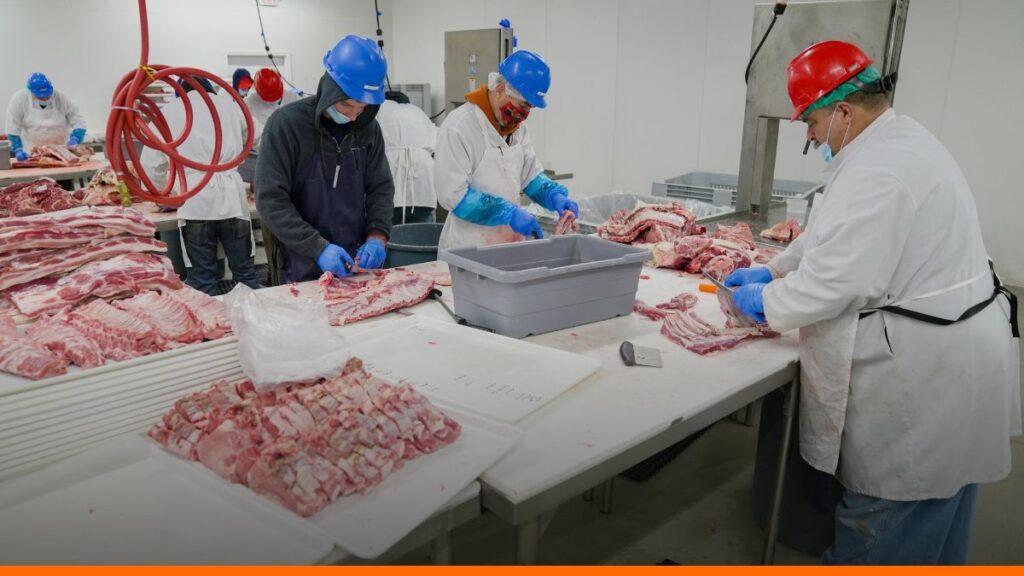
In short: On 3 July 2026 the Dutch government announced that from 1 March 2028, temporary agency workers (uitzendkrachten) may no longer work in slaughterhouses and meat processing. If you work in a meat plant through an uitzendbureau today, by then you will either have a direct contract with the plant or be working in another sector. The law is not final yet — but the direction is.
What exactly was announced?
The ban covers the whole meat-processing chain: slaughtering, processing, cooling and freezing, in poultry as well as red and white meat. From 1 March 2028 these jobs can no longer be filled with agency workers; contracts already running get a transition period until 1 June 2028, after which the ban applies in full.
There are two exceptions:
- Plants with fewer than 20 employees are not covered.
- Roles not directly tied to production (sales, administration) are not covered either.
Line workers, packers and cold-store staff supplied by agencies are covered — and that is the majority of Central and Eastern European workers in the sector.
Why the meat industry?
The ministry’s reasoning is blunt: since 2010 the sector has seen repeated serious abuses, typically against foreign agency workers — underpayment, poor working conditions, intimidation. According to the Labour Inspectorate (Arbeidsinspectie), agency workers face twice as many labour-law violations as directly employed staff. Reports put immediate dismissals in the meat industry at around 10%, against a national average of 0.65%.
The sector was given a chance to fix this itself: by July 2026 it was supposed to reach 80% direct employment. The result was roughly 50%. The government’s answer was not stricter rules but a ban on the instrument itself — agency work — in this sector.
Is this law already?
Not yet. The announcement opened an eight-week public consultation; after that the bill goes to parliament (Tweede Kamer). Dates and exceptions can still change there. What is certain: the government’s intent is clear, and the sector has been given 23 months to prepare. We will update this article when parliament has decided.
What it means if you work in a meat plant as an agency worker today
If the plant wants to keep you, it has to offer you a direct contract. This is the main consequence. A direct contract usually falls under the meat sector’s collective agreement (CAO), not the agency CAO (ABU/NBBU) — with different notice rules, different allowances, different sick-pay arrangements. That can be better, but it is not automatically better: compare line by line.
Housing is the critical point. For many agency workers the bureau provides the housing, tied to the employment contract. If your contract moves to the plant, the bureau’s housing does not automatically continue. Before you sign a direct contract, find out what happens to your housing — the plant provides it, the bureau keeps renting to you, or you have to arrange it yourself.
If the plant does not offer a direct contract, the bureau will move you elsewhere. That is not necessarily bad — logistics, food packaging and horticulture constantly have positions with housing — but it matters when you find out. In spring 2028 everyone will be switching at once.
What to do now
- Ask both the plant and the bureau what their plan is for 2028: direct contract, or reassignment. Employers already offering direct contracts now leave you less uncertainty.
- Find out what happens to your housing if your contract changes — ask for it in writing.
- Look at what direct-employer listings exist. On jobSCAN the “Directly from the employer” label shows that the company itself posted the listing, not an agency; the housing field shows whether accommodation is included.
Related listings: Jobs on jobSCAN →
Sources: Rijksoverheid — Verbod op werken met uitzendkrachten in vleesindustrie (3 July 2026) · NOS — Kabinet komt met verbod op uitzendkrachten in vleessector (3 July 2026) · Flexmarkt — Kabinet verbiedt inzet van uitzendkrachten in vleesindustrie vanaf 2028 (July 2026)
Stop searching — let the list come to you
One email a week with new jobs in the Netherlands. We will let you know when saved searches and accounts go live. Free, unsubscribe any time.